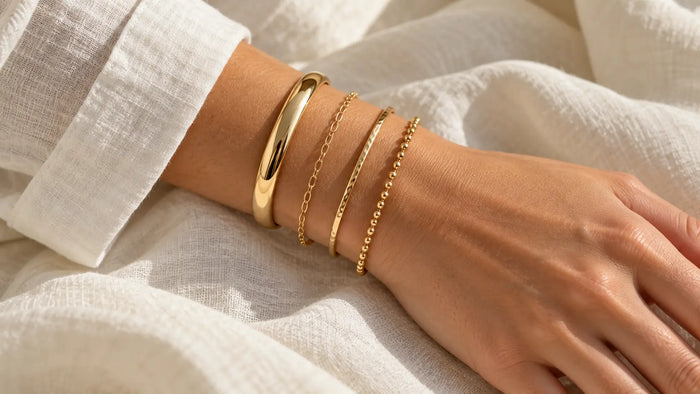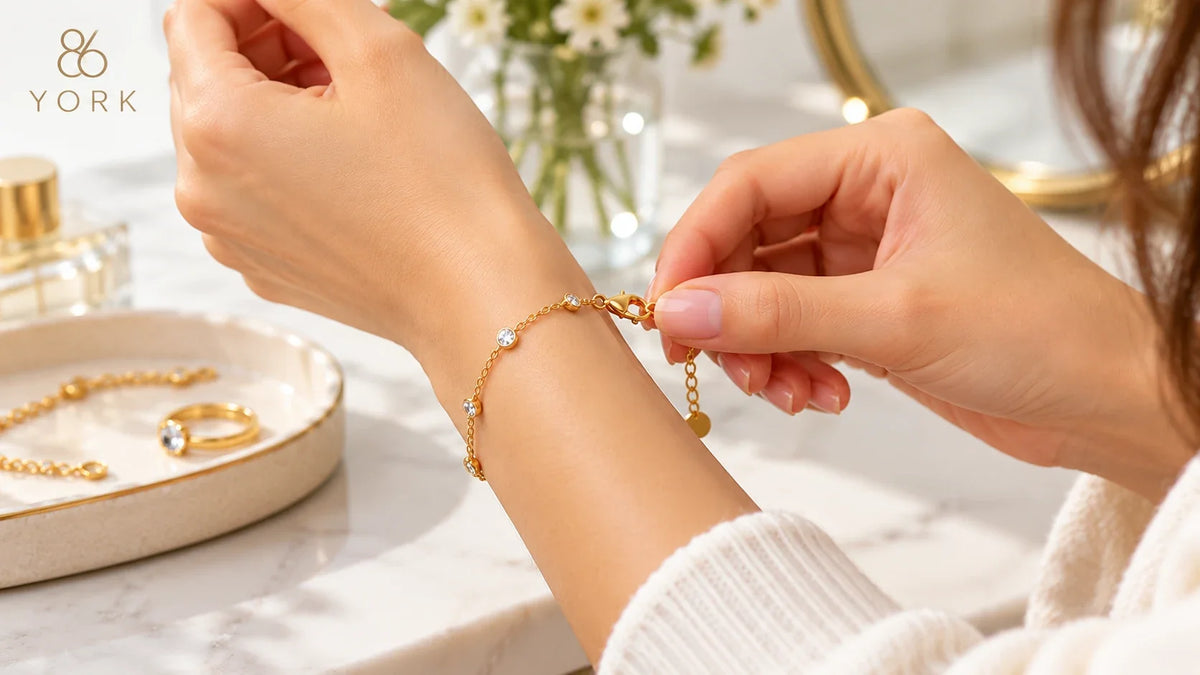
Here's how to put on a bracelet by yourself: hold one end steady, then close the clasp with your free hand. A small piece of tape, a bobby pin, or a table edge can act as your second hand. This guide shows what works for each clasp, so you can wear your favorite gold plated bracelets without asking for help.
Quick answer
Rest your wrist on a table. Hold the loose end in place with low tack tape or a bobby pin. Wrap the bracelet around your wrist and close the clasp.
Put the bracelet on your weaker hand. Your stronger hand is better at the small clasp.
How to Put On a Bracelet by Yourself: 5 Easy Methods
1. Hold one end with tape or a bobby pin
Lay the bracelet across your wrist. Stick a small piece of painter's tape on the chain, or clip a bobby pin to one end. Now the bracelet won't slide away.
Bring the other end around and fasten the clasp. Then peel off the tape or pin. Keep tape away from stones and delicate plating.
2. Use the table edge
Rest your forearm flat on a table with your wrist near the edge. The table holds the bracelet still. This helps a lot with thin chain bracelets that twist or slip.
3. Fasten it in front, then turn it
Wrap the bracelet loosely so the clasp sits on the inside of your wrist, where you can see it. Close the clasp there. Then spin the bracelet until the clasp sits where you like.
This is a good way to close a tiny bracelet clasp.
4. Slip it on like a ring
Some bracelets have an extender chain. Close the clasp on a link that makes a big loop, then slide the loop over your hand. Adjust it afterward.
This only works if the loop is wider than your hand at the knuckles. Test the size first. Never force it.
5. Try a bracelet fastener tool
A fastener tool is a small helper that holds one end of the bracelet while you close the clasp. It's useful if your hands get tired or stiff. Some brands, such as Gabriel & Co., suggest this kind of tool too.
Which method should you choose?
This table helps you pick how to put on a bracelet by yourself, based on your clasp.
|
Clasp type |
What it looks like |
How hard it is |
Best method |
|
Lobster claw |
Small claw with a tiny lever |
Medium |
Tape or bobby pin |
|
Spring ring |
Round ring with a small tab |
Medium |
Fasten in front, then turn |
|
Toggle |
A bar that slips through a ring |
Easy to medium |
Table edge |
|
Magnetic |
Two halves that snap together |
Easy |
Just bring the halves together |
|
Box clasp |
A tongue that clicks into a box |
Medium |
Table edge |
|
Bangle |
A hard, rounded bracelet |
Easy to medium |
Open the hinge or slide it on sideways |
Difficulty depends on your hands and the size of the clasp. Treat the table as a starting guide.
How each clasp works
Lobster clasp bracelet. Squeeze the small lever with your thumb. The claw opens. Hook it onto the ring or a link, then let go.
Spring ring. Hold the small tab open while you hook the ring. Release it to lock.
Toggle clasp. Slide the bar through the ring and let it lie flat. Keep the chain slightly tight so the bar doesn't slip back out.
Magnetic clasp bracelet. Bring the two ends close and they snap shut. If you have a pacemaker or another medical device, ask your doctor before wearing magnets.
Box clasp. Push the tongue into the box until you hear a click. Close the safety latch if there is one.
Bangle bracelet. Open the hinge, or gently squeeze an open bangle and slide it on sideways. Don't force a solid bangle over a hand that's too wide.
Many dainty pieces, like birthstone bracelets, use a small clasp and an adjustable chain. The fasten in front method suits them well.
Common mistakes to avoid
-
Making it too tight. You should be able to slide one finger under the bracelet.
-
Using your teeth. It stresses thin links and isn't clean.
-
Working over a sink or hard floor. If the bracelet slips, it can go down the drain or get damaged. Work over a table with a soft cloth.
-
Forcing a stuck clasp. You can bend the claw or strain the chain.
-
Putting jewelry on before lotion or perfume dries. Products can leave a film on the finish.
The same ideas work for anklets, since most use the same clasps. Anklets are harder to reach, so sit down and rest your foot on a chair.
If it still won't work
Even when you know how to put on a bracelet by yourself, some clasps are just hard. Here are easier choices:
-
Ask a friend or family member to help.
-
Choose a magnetic or slide to adjust style next time.
-
Ask a jeweler to swap the clasp for a larger one.
-
Don't wear a bracelet with a broken clasp. Get it repaired first.
FAQs
What is the easiest way to put on a bracelet with one hand?
Anchor one end with tape or a bobby pin, or rest your wrist on a table. A magnetic clasp is still easier.
How do I close a very small clasp?
Fasten it in front where you can see it, using good light. Then turn the bracelet into place.
What should I do if my bracelet is too tight or too loose?
If it's too tight, use a longer chain setting or an extender. If it's too loose, move the clasp to a closer link. Don't force a bracelet that doesn't fit.
Can a jeweler change my bracelet clasp?
Yes. A jeweler can often replace a tiny clasp with one that's easier to use.
Where is 86 York based, and what are its bracelets made of?
86 York is a women owned NYC studio that designs gold plated jewelry. Its pieces are made from 16k gold plated brass, according to the brand's website.
Final thoughts
Now you know how to put on a bracelet by yourself, whatever clasp you have. Pick one method, practice it a few times, and it will feel natural. If one trick doesn't work, try another, or switch to a clasp that suits your hands.